

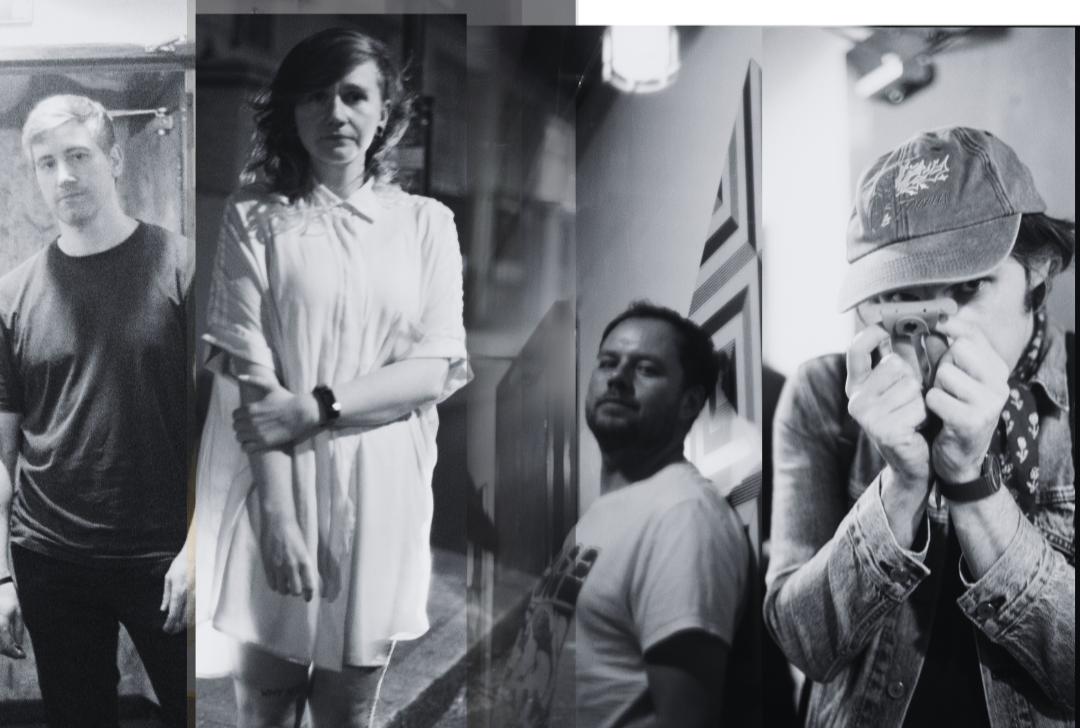
Feeble Strength is a traditional rock band from Sunderland and London, UK.
They sing songs from hymnary of millennial irrelevance and are often compared to The Weakerthans, Superchunk and Guided By Voices and The Lemonheads.
”Full of grandiosity and depth, a splendorous aural experience”
Razorcake Magazine
“Like a hymn or a religious exultation, highly evocative. Recommended”
Narc Magazine
Since forming in 2023, the Feebles have opened for the likes of Chubby And The Gang, Jeffrey Lewis, Martha, Simon Joyner, Titus Andronicus and many others.
Definitively a nerd’s band. Feeble Strength’s various inattentive ADHD related intense fixations, amassed over a lifetime of beach-combing the world for ways to console those of melancholic spirit are arranged in song on two records.
Their first EP Various Martyrs, filtered songs about heartbreak through references to Robert Owen’s New Lanark, grizzly early Christian martyrdoms, the Jarrow Crusade and the process of making manure from human waste.
Their upcoming record The Long Defeat (also about heartbreak, in all honesty), confronts romantic, political and economic losing battles with nods to JRR Tolkien, Calgalus’ speech to the Caledonians, The Spanish Civil War, the song Solidarity Forever, the Care Bears, the act of rolling coal, the Arthur Miller play Death Of A Salesman and other stuff nobody really pays attention to……because they are listening to the riffs. These riffs are usually described as ’90s’.
Additionally, they organise the multi-venue UK Grassroots music festival Marrapalooza in North East England (www.marrapalooza.co.uk)
From an interview in Razorcake Zine (available here) Interview by John Miskelly.
…
David: So anyway, in Feeble Strength songs right now there are two main themes of trade unionism and Christian Martyrdom.
John: Where's the connection between those?
Dave: Those things in songs are really just jumping-off points. We've got this song called “Call of the Mild.” I wrote it after reading about Robert Owen's intentional failed utopia in the U.S. in the nineteenth century, which was an early proto-socialist project. He bankrupted himself trying to make a commune, but I think if you've lived a life where you've thrown everything at stuff that was basically doomed, you get a lot of inspiration thinking about other people who've done the same idealistic things which were maybe a bit dumb. I was looking at projects like that and also the early Christians. I was thinking about the people that would profess a certain kind of belief but would never really act in a way towards...
John: ...Posers?
Dave: Yeah, posers. But a lot of things to do with, like, going into an arena and getting eaten alive by a lion for the things you believe in that aren't even of this world. I look back on that and think it's really impressive! [laughs]
John: And, what? You're equating trade unionism with that?
Dave: It's the way having sacrificed for things that you really care about in life is seen as such a mug's thing to do now, and really stupid. I wanted to still think about the value of people who still do things like that.
John: Like getting eaten alive by lions.
Dave: Those people who got eaten alive by lions changed the entire world as a result of it. In the socialist tradition, we still have heroes who went and did various different things, who suffered and really struggled for it. I'm generally attracted to stories of people who had to struggle through something to find some kind of meaning in life. Also, at the time, I was thinking about sacrifices I've had to make in life that weren't really valuable, and a lot of that stuff is psychological projection. I'm always questioning those kinds of things. I'm always thinking about meaningful sacrifice.
John: That it's good to have grafted, regardless of result?
David Yeah, definitely.
John: On that Christian theme, that's the protestant work ethic of just grafting. It's sinister when you look at it as that potential scam: “How do we get people to work their asses off and have them believe that that alone is valuable in itself and that alone is self-bettering?”
Dave: If you've ever been involved in punk or DIY or the grassroots scene in general, anyone out there will have had moments when they're like, “Why do I do all of this work?” There're only so many windows in life where you want to do something in life to the absolute best of your ability and you'd be a total fool to not grab it, otherwise you're just paddling around, not really knowing what your projects are. The reason why I think all this is important in the context of trade unionism—I come from a mining town and my first job was processing miners' claims. When Tony Blair came in, part of the NUM's (National Union of Miners) influence within the Labour Party was to get compensation for all the old miners who had the black lung. I was processing their claims and paying them out for things like emphysema and bronchitis. Even when I was really young, I had this grounding in the fact that a lot of people had sacrificed their bodies to make the economy work. So much of the heritage of the North East is based around communities that might be seen as really punk nowadays because they were people who came together to create their own social insurance systems, created their own cultures within towns of playing in brass bands, and things like that. They essentially built a life for themselves with an incredible amount of autonomy, solidarity, and community; and a lot of sacrifice in terms of battling for conditions. I think if you grew up with that stuff, or the legacy of that stuff, you're always aware of it.
John: I remember talking a couple of years ago about a temporary fascination you had with the ways in which Christian martyrs were martyred.
David: Oh yeah! John: Do you think you have a top three martyrs' deaths? Dave: Yeah definitely. I don't know how I'd rank them right off the bat, but Saint Sebastian had an incredible experience of martyrdom because he was shot through with arrows. It was Rasputin-esque. They shot him full of arrows and he still didn't die. He recovered, then was clubbed to death. On some of our merchandise we have a picture of a burning hand. A lot of different martyrs in Christianity are pictured, in paintings, in the way that they died, which is really goth if you think about it. Shit, I think St. Lawrence was grilled alive on a giant grid.
John: He was barbecued alive.
David: Yeah, and he said to one of the blokes who was barbecuing him, “Oh, you should turn me over because I'm done on this side!”
John: St. Andrew was crucified upside down?
David: It was St. Peter. He wanted to be crucified upside down because he didn't want to be crucified in the same way as Jesus, which I think speaks a bit to St. Peter's self-esteem. But it's also an iconic move, so... I think about the PR, mythos, and storytelling of the New Testament. The high drama is really amazing, but a lot of it actually happened. I just think the storytelling is amazing. We live in an era now where a politician won't do the right thing because it might jeopardize their contract with a private utilities provider in the following five years, whereas people back in the day with significantly more to lose would go and be burned alive for the things they used to think about. John: Things they couldn't even demonstrate, their faith. Dave: Total commitment to things that might not even be true. John: Total commitment to a movement. Dave: Who's a good example in the modern era of total commitment? This is the thing that I think is really interesting about that kind of stuff. I have a friend who was raised as in a Methodist family, and Methodism has a few different “corporal acts of mercy.” Methodism was very much like praxis-style Marxism: “How do you live the faith day-to-day, because that's what matters.” it's like, “What do you do?” ... punk. It has a few tenets that everybody sees in any DIY space: visit the sick, feed the hungry, [unclear]. I think it's interesting that [unclear] has no prestige or reward in society, really. You might even rack up not earning nearly as much as [unclear]. John: Do you think you'll carry on that as a concept band?
David: I wouldn't say it's a concept band. I have a lot of reference to other things that are also parts of my own emotional hinterland. We've got a song called “The Children’s Crusade,” which is inspired partly by the Jarrow March, but it's not about the Jarrow March. (A march from Jarrow in the North of England to London to protest the unemployment and suffering in the region at the time.) It's about going to bat for people in the face of other people who don't give a shit, and that line, “we are waterless canals,” is from an early gnostic text called The Apocalypse of Peter. I've written a lot of songs over the years that have reference to the apocalypse or end times. I don't know why. Things just kind of crop up in stuff if you spend long enough writing about any subject. I don't sit there and think “I'm trying to write a themed record”. it's more that the stuff comes out and you notice the themes afterwards. But I think the phrase “waterless canals” is really cool. In that text it's used to take the piss out of people who don't really believe in the gospel properly; it's like being a fake. So it's talking about yourself as a waterless canal, because you're not sure if you've got anything to offer the world. Those things are references to different bits of literature I might have picked up, and I tend to keep them in a Word document. I saved that phrase for about two years before I found something to put it in. Our song “Viva La Muerte” has a bit where it goes, “we stand outside starving from the wonders that we built,” which is from “Solidarity Forever,” but in that context it's more about being chucked out of a life you've built with someone else who didn’t have the same values as you. I just write down a certain phrase and then find I've written five songs about it. They seem thematically linked, but it's not that I sit down and write a record about Christianity or about socialism. It's just those happen to be things I'm really interested in, and they come through. In my previous band O'Messy Life we used to sing about suicide cults. I would tell people they were about suicide cults, but they weren't really. They were about being depressed about being at sea in life.
_____________________
David: That's the thing about working in the upper echelons of the music business. This is Britain's entire attitude towards music: it's, “We're trying to find the next success story,” and there's no emphasis on art for its own sake. The beauty of punk is you—if someone gets up and plays to people, whether that's a big deal or not, it's one of the best possible life experiences, and you don't have to be the most accomplished person to do it. You don't have to have a manager. You don't have to have someone who's decided you're worthwhile. We were talking about trade unionism and martyrs, and what's really inspiring about people like that is the total refusal to let another person decide whether or not you're good enough, or whether or not you're talented, or whether or not you have anything to offer the world, or what your value is. It takes an immense amount of headstrong perseverance. You might not get baubles thrown at you, and people might not think you're X or Y, but you still have something to offer the world. You're going to fucking do it no matter what. That attitude I've found with bands and DIY promoters around the U.K. has been a constant source of inspiration and meaning in life for me. Because in British music, if you're not one of the chosen ones then nobody cares. So, you have to make sure to be like, “I'm gonna get these fucking roses, as well as this bread and no one's gonna say I can't have it.” It takes a huge amount of spirit to think like that. So, the longer I've been in this scene the longer I've realized that just the day-to-day thing of getting up, playing the guitar, and getting to play in front of people will always be its own reward.
—————————-
John: Do you think it's more prevalent to want to see art made from suffering in punk because punks tend to revel in suffering sometimes?
David: The last song we played in the set yesterday was “Viva La Muerte,” and I'm sure Razorcake readers will be really keen to know this. It's a re-appropriated phrase from the Spanish Civil War. If you're a big time lefty bore like me, you've probably seen the film Land and Freedom. If you've been inculcated into lefty culture in the U.K., the Spanish Civil War is like...
John: ...utterly romanticized and a total misery fetish.
David: It's actually a phrase from one of the baddies in the Civil War, José Millán-Astray.
John: The fascists are the baddies, just to clarify. [Both laugh.] In the modern era there might be some ambiguity about that!
David: So there's a fascist leader of the Foreign Legion, who are utterly fucking ruthless. The Moroccan-based ones (the Spanish Legion, modeled on the French Foreign Legion).
John: Oh right, the ones that put down the Asturian revolution? (1934 anarchist/Communist uprising in the Spanish region of Asturias and a prequel to the Spanish Civil War.)
David: Yeah, he was called José Millán-Astray, and his legion's slogan was “viva la muerte” which translates as “long live death.” It came from a couple of situations. Obviously, the fascists were very close with the Catholic Church, and a Catholic priest was begging him to be more merciful in the way he conducted war. His response was just, “Viva la muerte, fuck mercy.” And there's a scene from a book about the Spanish Civil War where he's addressing a crowd of his soldiers and he's like, “Let the reds come and we're gonna show them what we're made of,” and his soldiers are like, “Viva José Millán-Astray!” He silences them and says, “Don't say Viva me, viva la muerte.”
John: He's got the brand slogan.
David: The guy's like a Bond villain. He had an arm missing. He had no fingers on his remaining hand. He'd had an eye shot out and a leg blown off. He was a completely destroyed person who'd found his life's meaning in fucking destroying everything else. John: So, get to the point where you explain why you admire this guy! Dave: I don't admire him! But at the time I was writing that song I was having to bury an adverse experience around a really long-term relationship ending. Thinking, “How do I psychologically get through this and try and put it behind me? Could I reappropriate this and erase the memory of this the way somebody might burn down a village?” It was more like the glory of destroying things. In context, it was a completely thing to do and my value system [unclear] about the mercy part. I felt asked by life to be like, “Yeah, . Let's destroy this.” I was saying this to Graham in my band and [unclear] because shit experiences make you stronger. And I said, “Yeah, they make you stronger. But they change you in fundamental ways.” It's a choice you make at that point. You could become Millán-Astray and be like, “You know what? Life fucked me, so I'm going to fuck everybody else,” or you can choose to do something different. I'm not trying to say anything about what someone should do in response to that. It was just the realisation that experiences like that change you and the compensatory narrative we have about trauma—“This made me stronger,” but in ways it made you a lot weaker.